

Cambridge Advanced National in Applied Science (AAQ)
HEAD OF DEPARTMENT
Ms S Patel
HEAD OF APPLIED SCIENCE
Dr A Osman
QUALIFICATION
Cambridge Advanced National in Applied Science
Level 3 Alternative Academic Qualification – Extended Certificate
EXAM BOARD
OCR
ENTRY REQUIREMENTS
6/5 in Combined Science
or
Grade 5 in each of the three separate sciences
Grade 5 in Mathematics
Grade 5 in English Language or English Literature
CURRICULUM INTENT
The Applied Science curriculum aims to develop students’ scientific knowledge, practical skills and ability to apply science to real-world situations.
Students will explore biology, chemistry and physics through practical investigation and applied contexts such as forensic science, medical physics and healthcare. They will develop skills in research, problem-solving, data analysis, evaluation and scientific communication.
The curriculum encourages students to think and work like scientists, building the confidence and independence needed for further study, employment and careers in science, healthcare and related fields.
Ultimately, our aim is to inspire students to understand how science can be used to investigate problems, interpret evidence and make a positive contribution to society.
ABOUT THE COURSE
Are you fascinated by how science can be applied to the world around you? Do you enjoy practical investigation, solving problems and discovering how scientific knowledge can be used in real-life situations?
The Cambridge Advanced National in Applied Science is an exciting Level 3 qualification that combines the study of biology, chemistry and physics with practical and applied scientific investigation.
From forensic biology and crime-scene evidence to medical physics and modern healthcare, the course allows you to explore how science is used to understand and solve real-world problems.
You will develop practical laboratory skills alongside the ability to research, analyse data, evaluate evidence and communicate scientific findings.
The course is particularly well suited to students who enjoy science but want to experience its practical and applied side.
WHAT MAKES THIS COURSE DIFFERENT?
This qualification brings together the knowledge of traditional science with the practical application of science.
Rather than studying biology, chemistry and physics as completely separate subjects, you will explore how scientific ideas and techniques are used to address real-world problems.
You could find yourself investigating a scientific question, analysing evidence from a forensic context or exploring how physics is used to diagnose and treat medical conditions.
The course combines 40% externally assessed content with 60% non-examined assessment, giving you the opportunity to demonstrate what you know through both examinations and practical, applied work.
YOUR PROGRAMME OF STUDY
The Extended Certificate consists of five units, giving you a broad foundation in the sciences before allowing you to explore particularly engaging areas of applied science.
F180 — Fundamentals of Science
90 GLH | External Assessment
Build your scientific foundations across biology, chemistry and physics.
You will develop the core scientific knowledge needed to understand more advanced applications and investigations.
Scheme of work - Fundamentals of science (F180)
F181 — Science in Society
60 GLH | External Assessment
Explore the relationship between science and society.
You will consider how scientific knowledge is developed, how scientists use evidence and data, and how scientific information is communicated.
Scheme of work Science in society (F181)
F182 — Investigating Science
90 GLH | Non-Examined Assessment
This is where you put your scientific knowledge into practice.
You will develop the skills to plan, conduct, analyse and evaluate a scientific investigation, working in a way that reflects the approach of a research scientist.
Scheme of work Investigating science (F182)
F185 — Forensic Biology
60 GLH | Non-Examined Assessment
Discover how biology can be used to investigate crime.
You will explore forensic evidence, cells, tissues and organs, evidence collection, analytical techniques and evidence interpretation.
This is an opportunity to apply biological knowledge to a fascinating real-world context.
Scheme of work Forensic biology (F185)
F186 — Medical Physics
60 GLH | Non-Examined Assessment
Explore the role of physics in modern healthcare.
You will investigate how physical principles and technologies are used in medical diagnosis and treatment, including both ionising and non-ionising techniques.
Scheme of work Medical physics (F186)
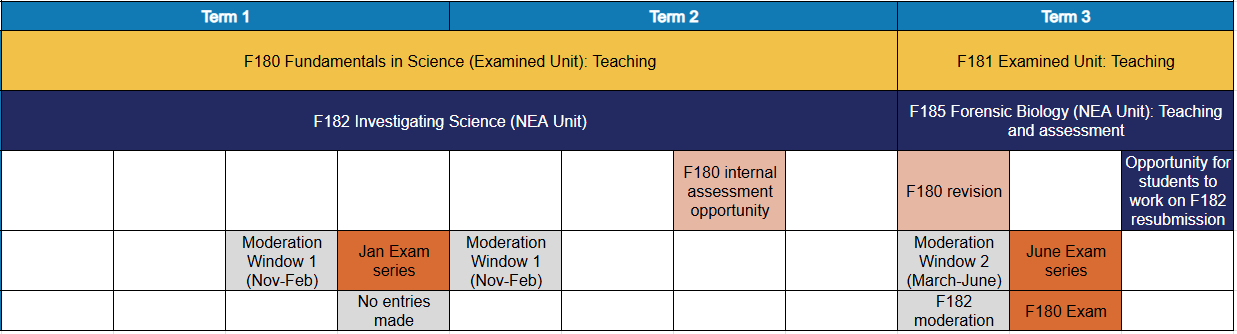
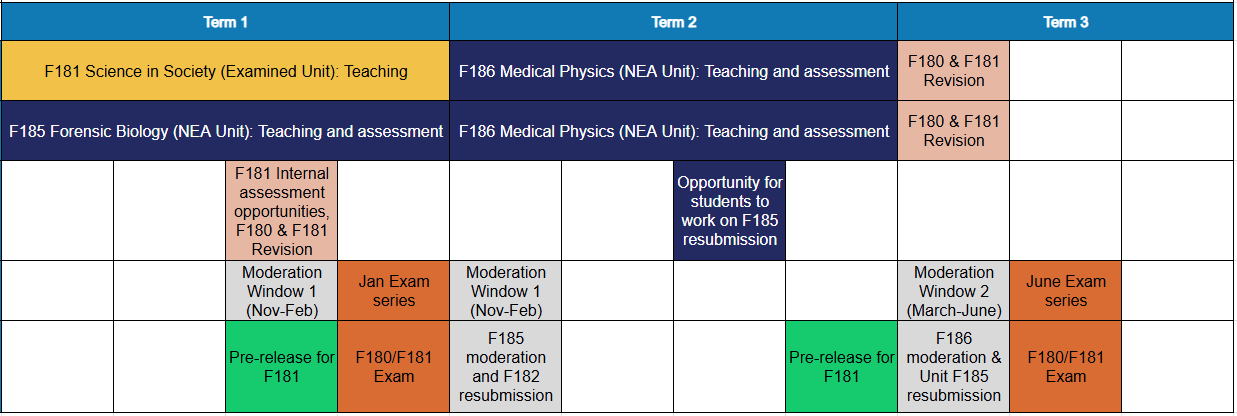
TERMLY SCHEME OF WORK
The course is structured progressively across Years 12 and 13, allowing students to develop their scientific knowledge, practical skills and confidence before applying them to specialist areas of Applied Science.
YEAR 12
YEAR 13
FROM THE LABORATORY TO THE REAL WORLD
Applied Science gives you the opportunity to see how the science you study connects with the world around you.
You will explore applications including:
Forensic Investigation
How can biological evidence help establish what happened at a crime scene?
Medical Diagnosis
How can physics and technology allow doctors to see inside the human body?
Scientific Research
How do scientists design investigations and decide whether their results are reliable?
Data and Evidence
How can scientific data be analysed and used to support conclusions?
Laboratory Science
How are scientific techniques used to investigate materials, substances and biological samples?
HOW WILL I BE ASSESSED?
The course uses a combination of examinations and practical, applied assessment.
| Unit | Assessment |
|---|---|
| F180 Fundamentals of Science | External Assessment |
| F181 Science in Society | External Assessment |
| F182 Investigating Science | Non-Examined Assessment |
| F185 Forensic Biology | Non-Examined Assessment |
| F186 Medical Physics | Non-Examined Assessment |
This balance means that success is not dependent solely on examinations. You will also be assessed on your ability to research, investigate, apply knowledge, analyse evidence and communicate your findings.
WHERE CAN APPLIED SCIENCE TAKE YOU?
Applied Science can provide a strong foundation for students considering further study and careers in a wide range of scientific, medical and healthcare-related areas.
Possible progression routes include:
-
Biomedical Science
-
Biochemistry
-
Forensic Science
-
Biological Sciences
-
Healthcare and Allied Health Professions
-
Medical and Health-related subjects
-
Other science-related university courses
The qualification can also form part of a mixed Level 3 programme, alongside A Levels or other Level 3 qualifications.
IS APPLIED SCIENCE RIGHT FOR ME?
This course could be a great choice if you:
-
Enjoy Biology, Chemistry or Physics
-
Like practical work and finding out how things work
-
Are interested in science beyond the traditional classroom
-
Enjoy solving problems and analysing information
-
Are considering a science, healthcare or forensic-related career
-
Want to develop skills for university study
-
Prefer a course that combines examinations with practical assessment
You do not have to know exactly what career you want yet. Applied Science gives you the breadth to explore different areas of science while developing practical, analytical and research skills that can support further study and employment.
READY TO EXPLORE APPLIED SCIENCE?
If you are curious about how science works in the real world, enjoy practical investigation and want to develop the skills to take science further, Applied Science could be the course for you.
Speak to our Sixth Form team to find out more about studying Applied Science.